Gold Outlook 2021 in a Nutshell

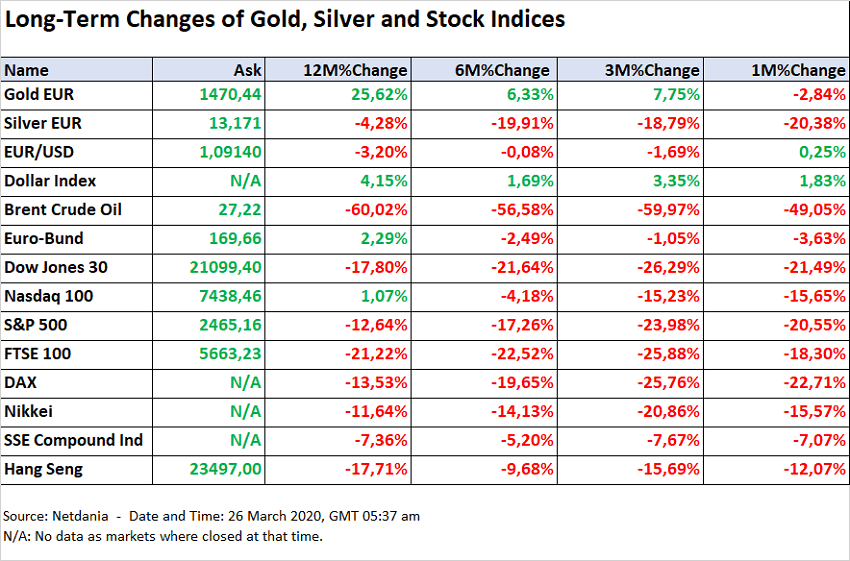
2021 will be a bullish year for the yellow metal, although the enormous hike in 2020 (24,6% per ounce in US Dollars and 14,4% per ounce on Euros, both the biggest hikes since 2010) may not be repeated this year.

Governments are printing (now called “monetary easing”) dizzying amounts of money to support suffering economies, ultimately leading to inflation. Zero and negative interest rates will continue. Fear and uncertainty will stay for several years. Gold will benefit as currencies are devalued an is expected to climb above $2,300 this year.


Reviewing Gold in 2020

In 2020, gold was one the best performing major assets. It also had one of the lowest drawdowns during the last year, helping investors manage volatility risk and limit losses and in their portfolios.

Gold’s performance last year was mainly driven by high market risk, low interest rates and a positive price momentum mainly during the summer.
Early August 2020, the gold price reached a historical high of $2,067.15 at the LBMA’a afternoon closing. This historical high was seen as well in all major currencies.

Later that year, the gold price consolidated but remained comfortably above $1,850 per troy ounce, finishing 2020 at $1,887.60.
An interesting finding in 2020 was that the metal’s price performance seemed to be linked more to physical investment, rather than to speculative futures market. We see the increased demand in physical gold, which we did also notice in our own business, as evidence that many investors used gold as a strategic asset and not just for tactical plays.

Central Banks’ gold purchases started at a high level in 2020 but became more variable in the second half of 2020, oscillating between monthly net purchases and net sales. Eventually, Central Banks ended the year as net buyers, however well below the record levels of 2018 and 2019. I do not expect 2021 to be much different as there are good reasons why central banks continue to favour gold as part of their foreign reserves.

Gold in 2021 at $2,300 and higher

Many analysts such as OANDA senior market analyst Edward Moya see the minimum target on a breakout at $2300 for the next leg higher. The analysts of Citibank, in their recent prediction, see the gold price rising to $2,200 in three months and to $2,400 per troy ounce within six to 12 months from now, lifting their forecast by $300.00, compared with its previous forecast.

The Australian bank ANZ predicts gold to surge to $2,300 early this year. The chief precious metals analyst at HSBC, Jim Steel, sees gold at $1,965 per ounce as the average price in 2021, though. However, Steel warned investors: “Gold is sensitive to geopolitical risk. If we’re going to get some rapprochement on the trade issues between the US and the other countries, and it’s not just one country, it could be from several, and we also get a charm offensive from the Biden Administration to US allies or to others, and the geopolitical risks come down and there’s the progress made on the trade front, then that would be negative for gold.”

There are other analysts that do focus more on the fundamentals of our monetary systems and are observing its erosion since some years. They see gold finishing 2012 at $3,250 per troy ounce. Although I agree on the continued erosion of our monetary systems and balances, I personally do not believe that the gold price will finish up this year well above $3,000. My personal expectation is rather in the range of around $2,300.

The Reasons for a High Gold Price in 2021

Monetary and Fiscal Stimulus has always been a driver for gold. The Coronavirus crises is lasting much longer than expected and has already damaged nations’ economies much more than initially predicted. Vaccines are on the market, but the vaccination of the critical mass of populations, which is around 65 to 70%, will not be reached before the last quarter of this year if everything goes well. However, vaccine producers already slowed down their planned output and had to partly cancel already agreed deliveries. It is also not yet clear if vaccines will stop spreading the virus, and if new mutations will emerge and whether current vaccines will be affective in such cases.

The European Union provided additional funds in a volume that has not been seen ever before, and surely that will not be the final one. Where does all that money come from? It is created artificially, which we call monetary easing nowadays. And it increases debts, putting a burden on everybody’s shoulders for long years to come. Along with this burden, negative interest rates will accompany us for many years.

In the United States, the situation is not quite different. Chicago Fed President Charles Evans recently said, “Economic agents should be prepared for… an expansion of our balance sheet…”, giving us more than a hint that the Fed’s monetary stimulus will continue this year. President-elect Joe Biden has explicitly stated that his “first priority” when he takes office is a stimulus package. The new Treasury Secretary Janet Yellen, who was the 15th chair of the Federal Reserve from 2014 to 2018, made it very clear during recent communication: more fiscal stimulus is coming. Although no figures are publicly announced yet, we should expect something in the range of at least $3 trillion in fiscal spending in 2021.

In line with increased stimulus, interest rates will remain very low in the US, with a chance to switch to negative interest rates this year (the “real” rate (10-year Treasury minus the CPI) is already negative in the US). The European markets are already used to negative interest rates, and they will continue. Low and negative interest rates are another driver for the price of gold.

Inflation is expected to rise, and the Fed had announced late last year that it is comfortable with inflation rates exceeding 2%, which does not come as a surprise, considering the US debts at 135.6% of GDP in 2020. Increasing inflation leads to increasing consumer prices, which in return will push investors to look for inflation hedges, and gold is an obvious choice and one that will push the price further.

The gold price in Dollar will perhaps not repeat its surge of 2020, but 2021 very much looks like a good year for gold again.


We do not offer investment advice:
This information is provided solely for general information and educational purposes. It is not, and should not be construed as, an offer to buy or sell, or as a solicitation of an offer to buy or sell, or as investment advice in general.

Silver Expected to Gain in 2021

After a 47% surge in 2020, silver is poised to continue its momentum this year. Most investment analysts and banks’ commodity traders expect silver to trade above $30 an ounce on average.

Silver started last year at $18. The white metal dropped below $12 during February 25 and March 18 as a result of hefty selloffs by large institutional investors who needed cash to meet their obligations arising from leveraged financial products linked to tumbling stock markets at the start of the Corona virus crises.

The silver price bounced back to its year entry level by the end of May and then surged to over $29 per ounce at the beginning of August, testing the $30 resistance level. After retreating to $22 toward the end of November, silver finished the year 2020 at $26.4 per troy ounce.

The Covid-19 crises is continuing this year, unfortunately, though the markets react with less panic than at the beginning of the crises last year. Vaccination seems to provide some hope for better containment of the pandemic during the second half of 2021, a hope which is further supported by the expectation for more governmental aid under the upcoming Biden rule in the US.

However, the “art” of money creation to cover suffering economies has added trillions of sovereign debts, mainly in the United States and Europe. It did not really help, though. Despite slightly improving national economic figures, some industries are close to a collapse, and millions of smaller businesses have closed down, perhaps forever. The burden of those sudden new debts and sharply increasing costs in the social welfare systems, combined with decreasing tax revenues for many years, is turning the interest to commodities, which are seen as “real value”, existing and tangible.

Silver is one of those commodities. Around one third of the global silver demand comes from investors, while two thirds are needed for industrial applications, such as semiconductors and solders in electronics, solar panels, water purification, batteries, and LED lighting as well as jewellery. A recovery of global industries, once the Corona crises can be better contained due to successful vaccination programmes, will support the silver price.

This view is also supported by the Head of Commodity Strategy at Saxo Bank, Ole Hansen, who is bullish for the silver price in 2021:

“Silver has always been a wily beast for investors due to its dual precious metal/industrial metal uses, and 2021 sees silver rising on both… Turbocharging the rise in the silver price in 2021, even relative to gold, is the rapidly rising demand for silver in industrial applications, especially those driving the green transformation such as photovoltaic cells used in solar panel production.”

The Covid-19 crises has increased the awareness for a greener and healthier world, for the reduction of CO2 emissions and for sustainable energy production. Many governments do not get tired from repeating that any state aid to companies suffering from the pandemic shall be provided only in connection with cleaner ways of doing business. The government of France successfully forced Air France to reduce its CO2 output as a condition to receive billions of aids.

The European Union announced that it will no longer subsidize any projects that are related to energy production by combustion, which is, on another note, a big blow for the gas exploitation dreams of Cyprus.

As clean energy is on the top of global agendas, there will be an increasing demand for silver, as the metal is an important component of solar panels. Although the amount of silver needed in solar panels has been decreased with advancing technologies, aiming for more cost-effective products, the total quantity of silver delivered to the solar panel industry continues to grow.

The research firm CRU expects solar power generation to nearly double by 2025, and the industry’s need for silver rising to 81 million ounces by 2030.

“Silver is our preferred play on rising investment in solar panels,” said Bank of America’s experts in a recent outlook report. The Bank made headlines two months ago when it dropped its forecast that gold will hit $3,000 this year, but it remains overweight in silver.

While Bank of America believes silver will be breaking through $31 in 2021, it expects silver to trade at an average of $29.13 an ounce this year.

The Canadian CIBC bank sees silver prices averaging around $32 a troy ounce in 2021.

“Even though the commodity has already performed well year-to-date, this metal has the potential to provide investors with even more torque given the relatively smaller market for silver vs. gold,” said Anita Soni, author of CIBC’s precious metals outlook 2021.

This outlook is also shared by Metal Focus, the U.K.-based research firm, whose analysts see silver prices pushing well above $30 an ounce in 2021.

“The recovery in silver industrial application is expected to outpace global GDP growth, with offtake in 2021 almost matching the 2019 total. Support will emerge from a range of end-uses, including photovoltaics and automotive demand,” said Neil Meader, Managing Director of Gold and Silver at Metal Focus, who has over 28 years’ experience as a commodity analyst.

Analysts at Metals Focus said a few weeks ago that further monetary stimuli are the main reason behind their forecast that the silver price will break through the $30 mark during 2021: “Almost irrespective of the outcome of the US election, fresh large-scale fiscal and monetary stimuli seem inevitable, given an uncertain economic recovery and still high Covid-19 cases. The same may apply to Europe where record infections and new lockdown measures have also cast doubts about the solidity of the anticipated economic recovery. The case for silver (and gold investment) will therefore remain strong.”

The U.K. metal advisors expect that the annual average price of silver will be rising by 40% this year.

 
We do not offer investment advice:
This information is provided solely for general information and educational purposes. It is not, and should not be construed as, an offer to buy or sell, or as a solicitation of an offer to buy or sell, or as investment advice in general.

Germany’s Untapped Gold Demand May Send Prices Higher

Gold has been an important part of Germany’s history for more than a millennium. The nation has a long history that involves gold, and it is widely owned among wealthy investors in the nation.

Today, Germany has become one of the biggest holders of the precious metal, being responsible for 10% of the world’s demand each year. Germans tend to be fiscally conservative, and as a nation, it has a relatively high savings rate.

Germany is not unfamiliar with the devastating impacts of hyperinflation and as such, 2020 has caused German investments in gold to reach record levels as investors and savers look to protect themselves from the economic impact of COVID19 and trade wars.

While existing gold investors see it as one of the best assets to protect their wealth and receive returns in the long term, some factors prevent other investors from adding gold to their portfolio.

According to a report from the World Gold Council (WGC), these factors range from environmental concerns to accessibility concerns, which need to be addressed to allow the German gold market to keep growing.

The Stage is Set for Gold to Rule

Germany is the fifth biggest economy in the world when measured by GDP and the largest economy in Europe, which has allowed its citizens to have a good standard of living that also enables them to actively save and invest.

The top five types of investments chosen by Germans are savings accounts, life insurance, gold, stocks and shares, and investment funds, and the nation shows a favorable attitude toward gold over other types of commodities.

With 18% of their income destined for savings or investment, 83% of the German population is considering investing in gold with 45% already having bought some in the past. Clearly, this could be a big force in the gold market, especially if Germans opt for physical gold.

Gold has historically been the go-to asset for millions of Germans who are wary of economic instability, which has helped the yellow metal to gain an incredible amount of trust in the European nation.

Gold Trading is Easier than Ever – but Could be Better

One of the main obstacles for investors that want to buy physical gold was the logistics required. Now, the use of gold-backed Exchange Traded Commodities (ETC) has opened the doors to new investors by facilitating the acquisition and selling of gold.

Investment in these ETCs are especially attractive to cryptocurrency investors, as they are twice as likely to acquire them than the average investor. This allows them to diversify their portfolio as well as easily trade it like any other digital asset.

ETCs offer investors frictionless transactions and added liquidity to their portfolios, as well as lower transaction fees and the possibility of quick trades, which allows ETC holders to also use them as an extra tool when it comes to trading in times of high volatility.

Although not as strong as that of crypto investors, real estate, and stock investors in Germany have also shown a favorable attitude toward ETCs. However, a higher percentage of them prefer vaulted gold, which still makes an impact on the gold market.

The continued improvement of the gold acquisition process is fundamental for the German market, as the ease of purchase is the main concern that comes to mind of those considering adding gold to their portfolio.

German Investors’ Attitudes Toward Gold

German investors have a positive perception of gold with 64% of them considering a good safeguard against currency fluctuations, 61% stating that it will never lose its value in the long term, 57% trusting it more than fiat currency, and 53% feeling more secure in the long-term when owning it.

This attitude towards gold shows that it is seen as a low-risk and sound investment that has the added benefit of being tangible, which provides an extra dimension of attraction.

Unfortunately, 50% of the respondents expressed that they never really hear about gold in the media, which has proven to cause investors to miss innovations like gold-backed ETCs when looking for new ways of investment.

German investors can be divided into 4 different segments: Adventurous traders, agile strategists, cautious savers, and guided risk-takers.

Each of these groups expressed different motivations and barriers that guided their attitudes toward gold, with each of them requiring different strategies from gold suppliers to increase the size of the market.

Gold Retail Investor Segmentation

The biggest investor segment is formed by adventurous traders, which represent 34% of German investors. They are followed by agile strategists (25%), cautious savers (25%), and guided risk-takers (16%).

All of these groups reported interest in gold investment by more than 30% of their members, with the highest percentage being 39% of the adventurous traders and 32% by agile strategists. This makes Germany one of the markets with the highest amount of investors considering investing in gold without having done so in the past.

The major barrier reported by all groups was trust issues, especially for cautious savers with 38% of them worrying about buying counterfeit or fake gold, which in combination with storage concerns are a big deterrent to new investors.

Another highlight of the report is that 25% of the respondents cited “It doesn’t generate an income” and 20% said “It doesn’t give high enough long term returns” as their main concern when investing in gold.

While 2020 caused several markets to suffer from heavy losses due to the economical and political turmoil caused by the COVID19 pandemic, gold investors experienced some of the greatest returns in recent years as gold reached an all-time high in both USD and EUR terms, which is sure to have an impact on the perception of these investors.

Germany is also known for its environmental awareness, which was reflected by the 25% who expressed that gold mining damages the environment, and as such, it would be unethical for them to support it.

Unlocking Gold Demand in Germany

While Germany already is one of the most important gold markets in the world, it is clear that there still is a lot of potential demand waiting to be untapped, and addressing the different concerns from potential investors is essential to do so.

The World Gold Council is aiming to increase trust in gold by providing retailers with a set of guidelines that facilitates the trading process while providing investors with a higher degree of transparency that allows them to invest confidently.

While it is true that gold mining has historically been environmentally damaging, a framework for responsible mining that benefits the local population and diminishes the environmental impact of the activity already exists.

Raising awareness around the practice and the local regulations around it would go a long way in addressing the concerns from potential investors.

Lastly, the lack of awareness around gold needs special attention when it comes to female and younger investors, as they represent the group with the highest potential to benefit from clearer communication and transparency.

Of course, the biggest influence that may drive gold higher is problems with fiat currency, as the ECB has shown that it is more than happy to debase the European common currency.

Germans still remember the hyperinflation of the 1920s, and as the European experiment enters a new phase where cheap money will be created to support a flagging political structure, more investors from the most wealthy European nation will likely flock to the physical gold market for safety.

 
We do not offer investment advice:
This information is provided solely for general information and educational purposes. It is not, and should not be construed as, an offer to buy or sell, or as a solicitation of an offer to buy or sell, or as investment advice in general.

Central banks continuous appetite in gold purchase

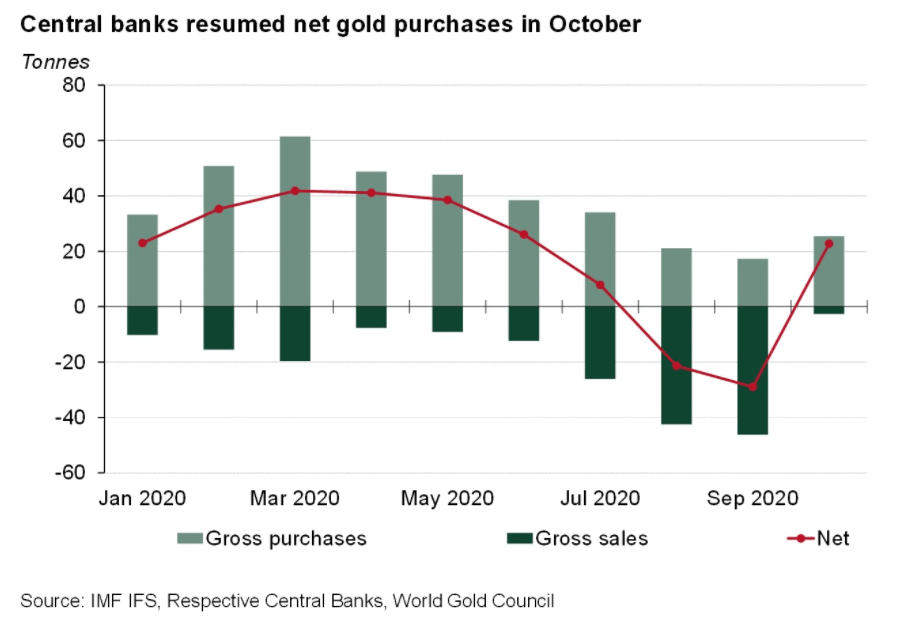
According to the World Gold Council’s Q3 Gold Demand Trends report, global official gold reserves rose by 22.8t on a net basis. Q3 2020 was the first quarter of net sales since Q4 2010, mostly as a result of the hefty sales from Uzbekistan and Turkey. This encouraged a re-concentration in gold demand of the central bank and whether this would change the mindset towards gold accumulation.

central banks gold buying

Gold’s position as a safe, liquid reserve asset

This year, gold has outperformed most of the traditional reserve assets and provided central banks with the extra power needed to make markets and currencies stable amid unprecedented levels of uncertainty. While it is expected to see some sales, considering gold’s position as a safe and liquid asset, the continued accumulation by central banks emphasises the important role of gold to central banks portfolio.

According to report, gross purchases of gold totalled 25t in October which mostly was by five central banks: Uzbekistan (8t), Turkey (7t), UAE (6t), Qatar (2t), and India (2t). On the other hand, gross sales were just under 3t during the month, mostly by Mongolia.

Y-t-d, central bank net buying continues to be between 200-300t. So far in 2020, number of buyers were more than sellers and most of buyers came from countries which largely have low ratios of gold-to-total reserves, indicating a continuous appetite to increase holding of gold assets at a strategic level.


We do not offer investment advice:
This information is provided solely for general information and educational purposes. It is not, and should not be construed as, an offer to buy or sell, or as a solicitation of an offer to buy or sell, or as investment advice in general.

2021 Could be the Best Year for Gold in Modern History

2020 has been one of the best years for gold as it reached its all-time high during a year when there was tremendous volatility in financial markets. All the pieces seem to be in place for 2020’s gold bull run to continue in 2021, as experts believe that gold will surpass the $2500 mark.

The simple fact is that there aren’t many alternative assets out there that are also liquid, and can be used globally for money. Central banks have opted to create enormous amounts of new money, and that policy is probably here to stay.


The Current Golden Opportunity

Gold is the most trusted investment vehicle in the history of humanity, as its intrinsic value has endured for all of human history. In addition to its role as global money with no political liability, it has numerous applications in different industries.

According to a report by the World Gold Council (WGC) back in September of 2020, gold offers better and safer long-term revenues, works better as a portfolio diversifier, has lower volatility, and offers higher liquidity than other commodities.

While other investment classes like cryptocurrencies, stocks, or real estate can only be considered luxury goods, hedging tools, have technological applications or protect against currency devaluation, gold is unique as it serves all of these functions and is a simple metal.

Technological advances and globalization have made it easier than ever for normal people to invest in different markets such as stocks and cryptocurrencies, which have gained popularity over the last few years.

However, gold has been falling behind when it comes to gaining new investors, which has resulted in low investment by individuals in the low to middle capital brackets, and it is being under-represented in commodity indices.

In short, this is great news from the perspective of an investor. Unlike the white-hot NASDAQ, one of the world’s most secure investments has gone largely unnoticed by the masses.

Gold’s Credibility is on the Rise

Current interest in new forms of investment is not the result of gold having lower performance than in the past, but likely has more to do with the lack of information that potential investors have when it comes to investing in gold.

Research shows that most investors in countries like the United States, Russia, Canada, India, and China have considered investing in gold in the past but haven’t done so due to a misunderstanding on what investing in gold entails.

That said, the recent pandemic and economic instability around the world has sparked a new interest in gold that has also resulted in greater availability of information for potential investors, showing them how investing in gold is not necessarily more difficult than investing in any other asset class.

Recently, the S&P GSCI and Bloomberg Commodity (BCOM) Index, two of the most important commodity indices, have decided to adjust their composition which will result in a higher weighting of gold. This is good news from the standpoint of gold’s public profile, as gold movements will have a bigger impact on the overall value of the index.

Gold Delivers Better Long-Term Returns

One of the best ways to understand why gold is so valuable to investors around the world is by looking at the returns it offers when compared with other commodities.
As of October of 2020, gold investors have received 28.10% in returns during the current year, which is impressive when compared to the -32.28% experienced by the S&P GS Commodity Index.

In fact, the closest asset follows at 9.36%, which is the return generated by Barclays Capital United States Treasury bills. This has also been the case over the last 5 years with gold’s revenue being 69.86%, which is reflective of the stability that gold possesses and sets it apart from other investments.
It is difficult to ignore these kinds of returns, and with the wild central bank policies that would appear to support higher prices globally, the price of gold is likely to move substantially higher in the coming years.

The Stability of Gold

Gold is known for having lower volatility than other commodities, something supported by historic revenue data and the CBOE/COMEX Gold Volatility index.
The yearly volatility rate of gold has never surpassed 30% since 2007, with it reaching 28% in 2008, only to stay under 25% ever since.

When combined, data on gold’s volatility and returns reflect the uptrend experienced by gold over the last decade, which was not halted even by the economic catastrophe that COVID-19 represented for global markets.

This makes gold more than a hedging tool against inflation or drastic economic depressions, as it has allowed its investors to generate gains over the long term, regardless of the economic backdrop. One reason for this is that gold is money, although central bankers won’t talk about that in public.

When we see the price of gold rising, it is really just the movement of centrality planned fiat currency falling in the face of an asset that can’t be created for political ends.

As the central planners need more funds to support their designs, there is a good chance that gold’s price will reflect the overall level of money in the marketplace. This has been the case historically, and there is no reason to think it won’t happen again.

Gold Might be Solid but Offers High Liquidity

The liquidity of gold is known to increase during periods of high stress in the markets as investors look for it as a safe haven. However, even in times of economic stability, gold is a liquid asset in itself that can compete with global stock markets.

Looking at the average annual trading volumes for 2019 shows that gold is in third place following the S&P 500 (all stocks) and US Treasuries. Gold had a trading volume of 145.5 Billion USD during 2019, while US Treasuries represented 149.7 Billion USD.

It is essential to keep in mind that gold liquidity increases in times of instability, which could result in 2020 being a year when gold shows higher liquidity than other types of investment by the end of the year.

2021 Will be a Golden Year

Gold will have the largest individual commodity weight increase in both indices as well as its highest weight ever in the BCOM in 2021 as a result of the indices’ adjustments.

The S&P GSCI index will be increasing the gold weight by 6.27% while BCOM will do it by 14.65%, a significant increase when compared to 3,73% and 12.24% of 2019.
BCOM’s precious metal group, which includes gold and silver, saw an increase of 1.6%, higher than any of the other groups in the index as the closest was the grains group with a 0.46% increase.

In the case of the S&P GSCI, the precious metals group had the second-largest increase in weight with a 2.37% increase, while gold had the highest gain for any individual commodity.

These events are especially noteworthy as the trend for other sectors was chaotic and differs by wide margins for both indexes, while a consensus can be seen on the growing importance of gold.

The WGC believes that other weighting metrics require further adjustments to get gold to be correctly represented. However, the two adjustments represent a positive step for gold as it reflects its position in the commodities complex and the increasing interest of investors.

A New All-time High for Gold is Coming

Citigroup, one of the biggest financial corporations in the world, recently predicted that gold’s value would reach the $2500 mark in 2021, which would represent an all-time high for the yellow precious metal.

Will Rhind, founder, and CEO of GraniteShares, said in an interview that all catalysts were in place for gold to reach its all-time high in a way reminiscent of the 1970’s bull market.

He referred to the recent and future performance of gold by stating,
“The conditions that drove gold to an all-time high this year are very much still in place. I think it’s just natural that once you get to an all-time high in an asset class, there’s some consolidation afterward and that’s what we’re seeing right now in terms of the price, But the fundamental conditions are still here and I believe that they will be here for the next 12-15 months minimum as well.”

On the other hand, Goldman Sachs said in a report that the bull market for gold was over for the moment as inflation was expected to move higher, which would allow the run to resume early next year, according to Forbes.

Regardless of the specific timeframe, many banks and investors are calling for higher gold prices. Most of these calls are anchored in the past price action of the metal, which may not be a great strategy for forecasting going forward.

In short, central banks’ policies have become unhinged, and major governments are running deficits that are awe inspiring. These are the kinds of policies that have been pursued in places like Argentine, Zimbabwe, or Venezuela.

The results from the perspective of gold prices have been incredible, and given the circumstances, gold could be offering investors not only returns, but a bridge to whatever financial system emerges from the current fiat era, once the current fiat model falls apart in spectacular fashion.


We do not offer investment advice:
This information is provided solely for general information and educational purposes. It is not, and should not be construed as, an offer to buy or sell, or as a solicitation of an offer to buy or sell, or as investment advice in general.

Demand for Silver Nanoparticles Set to Explode  

As technology advances and companies around the world look for new medical approaches to diseases and research solutions, silver nanoparticles have found fertile ground to quickly become the hottest thing in the silver market.

Silver has historically been one of the most trusted commodities when it comes to investing and hedging for losses, but it has quickly become so much more than that. Silver can save lives, and the demand for silver nanoparticles is set to rise by more than 400% over the next eight years.

Silver in the Times of Corona

The Covid-19 pandemic has reshaped different industries, markets, governments, and normal people as a result of social distancing and other restrictions placed to reduce the risks of infection.

While most media outlets and experts are focusing on the negative impacts the virus had, the opportunities that the crashes caused by it are usually not talked about.

Here at Liemeta, we specialize in providing our clients with great precious metal buying options, and a depth of industry knowledge. The silver supply is primed to come under pressure in coming years, and the move to integrate silver into the medical field will only add to this supply crunch.

If you want to learn more about what we do at Liemeta, please contact us for more information about how we can help you enter the precious metals space.

A Rush to New Ideas

It is true that both the pandemic and its handling harmed the global economy, it is also fundamental to discuss the doors that are opening as the world continues its fight to return to normality.

Consumers and enterprises have started to get used to the new normality we are living in today as well as found ways to work around the challenges they face.

The end of the chaos period is getting closer by the second and those who are ready will benefit greatly from investing now.

Silver Nanoparticles are Hot

Experts expect the silver market to keep growing over the next years as industries around the globe continue to recover and technological advancement takes place.

One of the latest applications that have played a crucial role in the success of silver investments is the use of silver nanoparticles in the medical fields

While these particles have multiple applications in the textile, biomedical, and electronic industries, the one that has gotten the most attention in recent months has been in the medical field.

Silver nanoparticles have been known to have antimicrobial, anticancer, larvicidal, catalytic, and wound healing characteristics, but in recent months have started to be used in experimental Covid-19 and antiviral treatments by companies like CollPlant.

These new applications and the economic recovery have resulted in forecast predicting a compound annual growth rate of 15.7%, allowing the silver nanoparticles market to reach
$4.1 Billion by 2027.

This represents a growth of over 400% when compared to the $792.1 million it had in 2014 and the predicted $2.54 billion in 2022.

These predictions reflect the enormous potential of a growing niche in the medical field and silver market, which is just a small piece of the whole catalog of application silver has and those who take advantage of it earlier are sure to benefit the most.

An Already Tight Market

The silver surplus for 2020 is projected to come in at just 15 million ounces of the white metal, which is the lowest in five years. China has also been racing to secure physical supplies of silver, which may become a new trend and nations look for alternative assets to Western fiat currencies.

Ongoing economic shocks have not been positive for silver mine production, which was only forecast to rise by 2% in 2020. If there is a large new market for silver, the price will have to rise to compensate for the lack of excess supply in the marketplace.

The Silver Lining of 2020

Silver has several industrial applications in electronics, soldering, medical equipment, photography, water purification, and many more.

Given these demand factors, its price suffered a severe drop back in March when supply chains broke, demand decreased, and companies around the world had to halt their operations.

It would be on March 18 when silver would reach its all-time low in the last year at $11.74/Oz, just to steadily start climbing as new investors poured in to use it as a hedging tool.

Since then, Silver experienced a constant recovery getting close to a value of $30 after starting the year at $17, a performance that few commodities have been able to match.

While 2020 was a rocky start for silver investors, those who were patient or courageous enough to invest when its value dropped, have seen a great return on their investments that is likely to continue.


We do not offer investment advice:
This information is provided solely for general information and educational purposes. It is not, and should not be construed as, an offer to buy or sell, or as a solicitation of an offer to buy or sell, or as investment advice in general.

Russia’s Gold Market is Huge and is Likely to Grow Larger

Russia is one of the countries with the most potential for future growth when it comes to gold investment. As a gold producing nation, Russia has a natural affinity for gold, and many Russians currently invest in the yellow metal.

For most of Russian history, gold has been a sign of wealth, stability, and economic progress. This has been reflected in the country’s position as the world’s biggest buyer of gold in early 2020. Despite this, there is lots of room to grow.

The gold market is still underdeveloped when compared to other financial markets, although this is likely to change in the coming years.

Russians Love Gold

It isn’t a surprise that according to the World Gold Council (WGC), 79% of Russians are considering investing in gold and at least 66% of them consider it one of the best methods to fight inflation and protect themselves from currency fluctuations.

The public’s existing perception of gold makes Russia a country with potential for an increase in gold investment. Knowledge of how to invest in gold is still an obstacle, but it can be easily solved.

Providing potential investors with information and support to educate them on gold investment would open the country even more to the global gold market. As Russia is already a leading nation for gold investment, added demand would likely push prices higher.

Different Types of Investors

There are four main types of retail investors that the WGC identifies, and each type is defined by how diversified a portfolio is, their risk avoidance, and their attitude toward gold.

The first group is composed of investors the WGC calls “Agile Strategists”.

These investors have a long-term view of the markets, diverse portfolios, and tend to be early adopters. In this group, 55% of the investors consider gold purchases. According to this group the biggest issue with making gold investments are the high buying and selling fees, as well as concerns about authenticity.

“Adventurous Traders” are part of the second group. Unlike Agile Strategists, these investors take short-term positions, are less risk-averse than other groups, and experiment more when it comes to investing. 52% of these investors consider gold investments, with gold prices and concerns about safe gold storage being their main concerns.

The group with the highest percentage of members that consider buying gold are “Cautious Savers”, who are known for being risk-averse, look for steady returns, and aiming to hedge for economic fluctuations.

Of the Cautious Savers, 60% consider buying gold, with the biggest obstacles toward investing being affordability and storage, which matches the adventurous traders’ perspective.

The last group, called “Guided Risk Takers” by the WGC, are those who look for high returns in the short term. While not entirely risk-averse, they are known to rely on third-parties when it comes to decision-making. In this group 55% consider buying gold, and they cite affordability and storage as the main barrier to actually making a gold investment.

Targeting the obstacles perceived by each group is sure to attract more investors by facilitating gold acquisition, and many of these concerns are simple to address.

Creating Opportunities for Gold Investment

Based on the research from the WGC – it is easy to see that there is massive room for more gold investment in Russia. A big part of realizing that potential will be to streamline the gold investment process by dropping transaction costs and increasing transparency.

There is renewed interest in gold with many major investors entering the sector. As more retail investors realize what is happening to the global economy, gold investments both in Russia and internationally are likely to ramp up.

Russia is one of Liemeta’s Key Markets

Liemeta provides excellent solutions to buy investment grade gold delivered directly from the refineries, and to store safely in one of Europe’s most secure and purpose-built private vaults in Liechtenstein.

Contact us now for a first Zoom meeting, which is of course complementary.


We do not offer investment advice:
This information is provided solely for general information and educational purposes. It is not, and should not be construed as, an offer to buy or sell, or as a solicitation of an offer to buy or sell, or as investment advice in general.

Silver Could Further Outperform Gold in Massive Metals Rally

The future of the world’s biggest economy is uncertain as social and political unrest keep growing. COVID-19 has ended the global economy as we knew it, and the pandemic continues to evolve. There aren’t many assets that will do well in this environment, but silver might be one of the best.

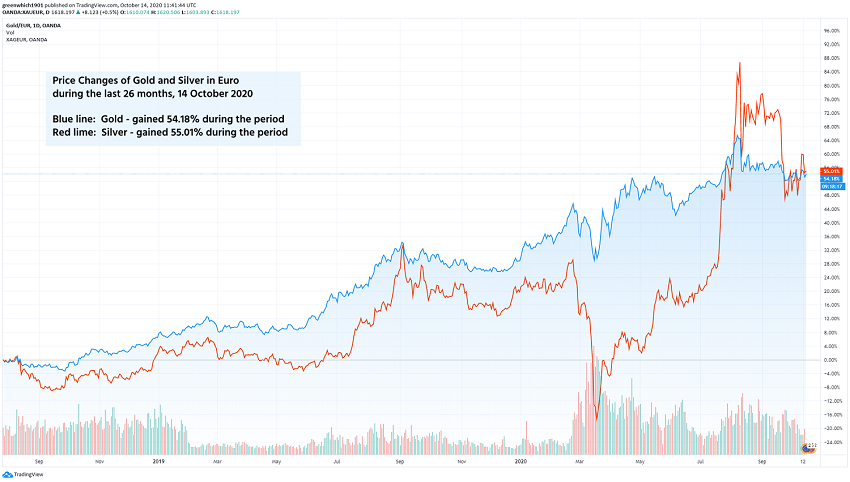
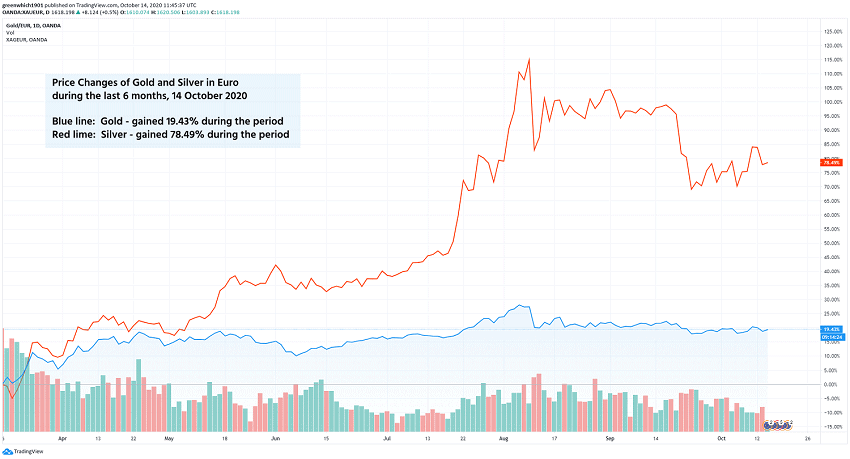
Gold Silver Performance last 6 months

This once in a lifetime pandemic has resulted in an unprecedented election race for the United States, not only due to the dichotomy of social distancing and the democratic process but also for its effects on the stock market.

Out of all the precious metals, silver has been proven to be one of the most popular and beneficial options for investment. The main reason for this is that it shares most of the properties of gold when it comes to investing as well as historical significance, but it also has loads of industrial applications.

Precious Metals are Attracting Big Names

The United States situation has forced investors around the world to look for other investment opportunities beyond traditional stocks.

Real Estate, cryptocurrencies, and precious metals have been growing in popularity as people around the world get ready for the worst-case scenarios as an American economic crash would surely have a global impact.

There have been reports of investment giants like Warren Buffet, Eric Sprott, and Robert Friedland investing in both gold and silver in recent months.

If you want to learn more about how we can help you acquire physical silver, we are here to help. At Liemeta ME Ltd., we specialize in high-grade precious metals, and we can find the best silver products to fit your investment goals. While silver prices have risen this year, we think the big gains are still coming!

Buffett Bets Big on Precious Metals

Warren Buffett’s Berkshire Hathaway, which has historically been adverse toward gold investments, has invested in Barrick Gold.

The mining company is present in over 13 countries and had a revenue of 9.7k million dollars in 2019 resulting from its gold, silver, and copper mining activities. Berkshire Hathaway reportedly invested over 500 million dollars to acquire 1.2% of the company, which was surprising to many experts due to the company’s previous disinterest in gold.

On the other hand, Canadian billionaire Eric Sprott has invested in Vizsla Resources Corp, Orefinders Resources Inc., and Pure Gold Mining Inc. All of the companies located in Canada focused on the extraction of precious metals. Mr. Sprott’s interest in these three companies was not a small event, as more than 25 Million Canadian dollars were invested.

Robert Friedland, a billionaire deep in the mining industry, has increased his investments in the mining company Ivanhoe Mines Ltd – which he already had a substantial stake in.

These moves by some of the richest companies in the world point at what is already known by many investors: turbulent times are coming for the global economy and hedging is needed.

Silver is Outperforming Gold and Platinum

Over the past few months, America’s partners have grown increasingly wary when interacting with their ally at all levels: politically, economically, socially, and even technologically. As if this were not enough, the United States has been in an economic war with China for the last two years – which has further exacerbated the economic turmoil.

While the stock market has always been sensitive to elections and major events around the world, the approaching American election has shown a bigger influence over it. This influence over the market has resulted not only in highs and lows for investors but also for the American economy itself, with the obvious effects that it has on other countries.

For most of history, precious metals have proven to be valuable commodities that are associated with luxury, wealth and economic safety due to their intrinsic value. Nowadays, this is still the case but the metals have evolved to also have applications beyond aesthetics.

Over the last decade, more patents have been filled for products requiring silver than gold due to its reflective and electrical/thermal conductivity properties.

Given the fact that a small quantity of silver is used at a given time, it is also not worth it for producers to recycle existing hardware but to acquire it by mining or buying. This means that the demand for silver is not only greater than other precious metals but also that the limited supply available is likely to diminish quicker, increasing its value.

Gold Silver Performance last 26 months

Silver Blasts Higher

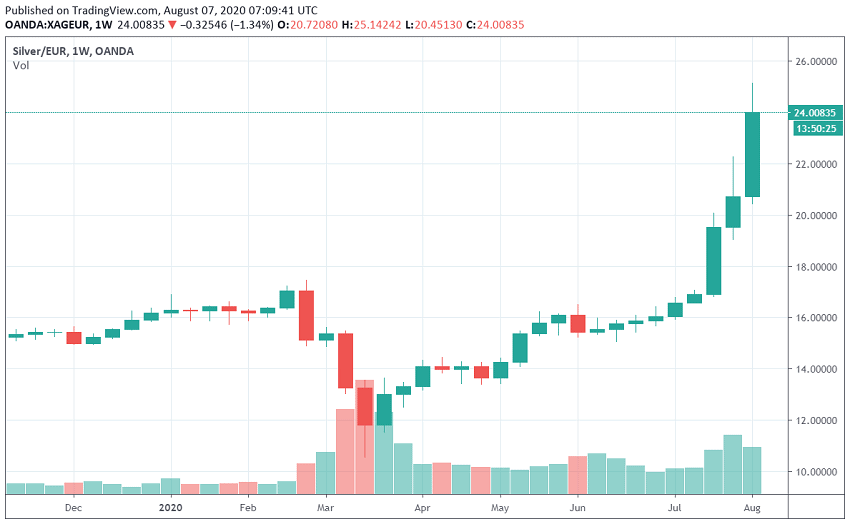
Increasing interest in silver has been confirmed by the white metal’s value increase of over 100% over the last six months, the highest of any precious metals. There are reasons to believe that this uptrend will continue as it has been experienced by other metals, which has historically proven to be an indication of higher returns of investment going forward.

Six of the last times when both gold and silver’s value increased, silver investors experienced higher gains. Many analysts think that silver is highly undervalued right now, which would mean that any correction lower in price would be a buying opportunity.

Buying silver right now will not only allow investors to hedge for losses in other assets, but also provide greater gains than any other metal. If we are to believe historical trends and statistics, the recent increase in the value of precious metals is sure to have a higher impact on silver, rewarding investors handsomely as the long-term shift away from fiat money continues.

This article has been published at the Cyprus Financial Mirror.


We do not offer investment advice:
This information is provided solely for general information and educational purposes. It is not, and should not be construed as, an offer to buy or sell, or as a solicitation of an offer to buy or sell, or as investment advice in general.

Platinum is an Overlooked Precious Metals Investment

Platinum is known for its value and scarcity, attributes that make it attractive when compared to other Precious Metals (PMs) and financial assets. As one of the rarest financial assets there is, platinum could be a stand out asset over the coming decade.

As a result of the COVID-19 pandemic, the platinum mining industry has suffered as government lockdown measures limited platinum’s industrial activities globally. This has led to a near 95% drop in South African production, which may not be resolved in the coming year.

An updated 2020 forecast has moved its market into an annual deficit of -336 Koz compared to the prior estimate of a +247 Koz surplus, and investment demand for the metal has picked up as other precious metals have come under increasing demand.

An Undervalued Asset

The decline in refined production and recycling supply in the platinum space could lead to potential price hikes. Wild central bank policies appear to be driving investor demand for hard assets, with platinum bar and coin demand forecast to by 113%, reaching 600koz in 2020.

Although platinum’s performance varies depending on the state of the global economy and the laws of supply and demand, this is also true for other investment assets.

Unlike manufactures’ shares that rely on government bailouts and equity investors to have value, platinum is leveraged to both the industrial cycle – and safe haven buying. As a hard asset, platinum has no counterparty, and will have value regardless of central bank policy.

While gold offers less to investors that want to have exposure to an economic recovery, platinum will allow your portfolio to play offense and defense simultaneously. At Liemeta we can help you find the right platinum products to fit your investment goals.

Please give us a call to learn more, or look at the information on our website, https://liemeta.com.cy/

Platinum Occupies a Unique Position in the PM Market

Platinum differentiates itself from other precious metals by offering extensive applications in the market. It’s currently used in the automotive, jewelry, recycling, petroleum, chemical, electrical, glass, medical, and biomedical industries.

The precious metals industry as a whole has been affected by the global pandemic. With many platinum-dependent industries suffering as the world’s economy stopped, there could be new opportunities opening as the global market starts stabilizing.

Both glass and medical industries have maintained higher demand and show signs of improvement when compared to other markets affected by the crisis, as both are vital to overcoming the medical issues the world presently faces.

The Automotive Industry is Moving Again

By being one of the first countries to control COVID-19 and enable the return of industries, China has spurred a strong recovery for platinum, especially in the automotive sector with the help of its partial adoption of China 6 light-duty and China VI heavy-duty vehicle emission regulations.

Platinum plays a crucial role in facilitating the hydrogen economy by generating green hydrogen and for its use in fuel cell electric vehicles.

European automakers have been preparing technical changes to reduce new CO2 emissions for many years. Platinum demand is expected to grow as automakers employ it for CO2 reduction strategies.

Although data on the quantity of platinum used cannot be released by these manufactures, it is suggested that it is large and will move the PGM market.

The Jewelry Comeback

As restrictions eased, China’s jewelry recycling more than doubled during Q2’20 compared to Q1’20. Despite other countries not showing this same growth, the world has shown higher interest in platinum jewelry, allowing more demand to enter the market.

Platinum price attractiveness when compared to gold should continue until prices move up substantially, as platinum is far rarer than gold.

Other countries are expected to show an increase in the jewelry industry towards the end of the year by appealing to both retailers and consumers as a result of its widened discount compared to gold.

In addition to this, the global bridal market is expected to return, and may boom as rescheduled weddings affected by COVID-19 go ahead. There is probably significant latent demand for platinum from across a range of industries, once this demand becomes active, the price of platinum will likely shoot higher.

A Good Time to Invest

Positive platinum market fundamentals are presumed to provide an added appeal to platinum from an investor perspective. Its forecast deficit, demand growth potential, and price discounts to gold and palladium all contribute to platinum’s value proposition.

While COVID-19 affected the platinum demand equation, it also contributes to the growth of investment demand since global authorities’ monetary and fiscal policy response to the pandemic resulted in huge amounts of money creation.

The global economy is still in a difficult situation, but buying precious metals is simple with us. If you want to add to your PM positions, or make your first purchase, get in touch with us today.

At Liemeta we know the PM markets – and can offer you the best products. If you need some help deciding which metal would work best for your goals, or you need to find a specific product, please contact us through the form below and we will be happy to revert to you.

We do not offer investment advice:

This information is provided solely for general information and educational purposes. It is not, and should not be construed as, an offer to buy or sell, or as a solicitation of an offer to buy or sell, or as investment advice in general.

Gold Investments: What you might want to consider

Gold has been of the most important commodities in the history of humanity. Central banks have been adding to their gold holdings, but retail investors are not buying gold at nearly the same rate.

The World Gold Council estimates that retail investment in gold has increased by 15% each year since 2001, with about 40 thousand tonnes of gold owned by retail investors at the end of 2019. While that is a large amount of gold, the current issues that central banks face could drive retail gold demand much higher.

The US is running record deficits, and central banks are adding trillions of USD to the global money supply. As people look for better ways to buy something that has lasting value, gold ownership rates – as well as prices – are likely to rocket higher.

A Lack of Trust Still Exists in the Gold Market

According to the World Gold Council, half of the prospective gold investors find a lack of trust in third parties to be the main barrier of entry to the gold investment world. This is the result of a lack of regulation for different gold products.

From the type of gold products to its management, knowing what you are doing when investing in retail gold is essential to make the right decision and maximize your profit opportunities while avoiding losses due to a lack of information.

While investment options like stocks, property, and cryptocurrencies have become increasingly popular, gold remains one of the most stable forms of investment as a hedge to fist currency weakness.

If you are looking for a way to divest some of your fiat assets into stable money – we can help. At Liemeta we can ensure that you will buy the best gold and silver products in the market, no matter what kind of form factor you are interested in buying.

Please give us a call to learn more, or look at the information on our website. 

We know how to deliver the best and want our clients to have the kind of safety that only precious metals can provide.

Choosing the Right Type of Gold Products

Investors who are not familiar with gold, and even those who are, might not be aware of all the different options that exist when investing in gold. Each kind of gold will have its own benefits, and it is worth considering your options before you buy.

There are the classic gold bars/coins which are known as Bullion gold. These gold bars and coins vary in sizes, which determine their value of depending on the gold content.

Collectible and Numismatic coins, on the other hand, are not considered bullion gold due to the added value that their scarcity and design providers, which is usually of importance to collectors in the same way of works of art or antiquities do.

While they are good investment options, they require a high degree of expertise and complexity that adds an extra layer of difficulty in owning these items.

Gold Jewellery is another popular alternative when it comes to smaller retail gold investment.

To be considered a valid gold investment product the jewellery must be highly pure as this is the main aspect providing it value, with any other unique properties providing extra value. Just like numismatic coins, this type of product adds another layer of expertise to the trading.

The added complexity of Gold jewellery and collectibles make them more complex than bullion gold, also increasing its volatility and risks. While there are gold investment alternatives that do not require the physical possession, most investors agree that you do not really own your gold if you do not hold it.

Different Fees for Different Products

One thing that new investors do not look at when selecting a gold product to invest in is the fees and costs that they will incur in by acquiring and maintaining them.

From transaction to storage fees, all of these should be kept in mind at the time of acquiring gold, looking at different options and the benefits they offer when it comes to safeguarding your investment. That does not mean that the option with the lowest costs is always the best one. The Gold investor needs to analyse the value for money.

As investment jewellery and collectibles require a degree of expertise that will prevent most investors from acquiring them, we will focus on bullion gold for now.

One of the advantages of bullion bars and coins is that they are exempt of Value-added Tax in a lot of jurisdictions, so it is important to understand any taxation issues you may face.

Bullion gold has some of the lowest premiums of any gold product, which also decreases as the size increases and is driven primarily by the melt value of the coins or bars. Bullion gold investors typically prefer gold in form of one-kilogramme bars, as their premium is lower than the premium for smaller bars.

The benchmark for gold prices is mainly defined by London’s over-the-counter market, the US futures market, and the Chinese Gold market, as they represent 90% of the global market when it comes to trading volume.

Make Your Money Work in the Precious Metals Market  

While it is possible for investors to hold their gold themselves in their home or office, it is not recommended due to the risks involved.

This is why most investors will make use of professional storage services that provide security and ease of mind by safekeeping the assets with top-notch security and ease of access to owners, often preferring high-security private vaults.

These services are usually charged on an annual basis with the fees calculated based on a percentage of the value of the gold that is being stored, on a daily basis. It is important to be aware of any other costs you might incur on for using them as services like delivery could not be included. Such other costs could be an insurance fee, which might be included in the storage fee, or not. It is also advisable to compare the coverage of insurances.

Gold bullions stored with accredited vaults may also be used as collateral for Lombard loans. Lombard loans are loans that are secured with physical valuables, such as physical gold, for example.

If you want to learn more about gold or silver, please contact us. The price of gold and silver has been rising over the course of 2020, and this is probably a good time to enter the precious metals market. You can learn more about what we offer on our website or call us directly on +357 222 72 320. Or you may contact us through the below contact form.

We do not offer investment advice:

This information is provided solely for general information and educational purposes. It is not, and should not be construed as, an offer to buy or sell, or as a solicitation of an offer to buy or sell, or as investment advice in general.


We ordered silver for EUR 60 million for our clientele. Don’t miss this opportunity!

The silver price in EUR raised 120% since 19 March 2020 and is likely to further surge substantially.

Therefore, to satisfy the increasing demand of our clientele, we ordered silver for EUR 60 million, mainly 1,000 oz (31.1 kg) Standard Bars, approx. 30% 1 kg bars., from our LBMA-certified refinery suppliers.

We accept physical purchase orders at a minimum of EUR 200.000.

Store in our state-of-art private vaults in Liechtenstein

Benefit from our sophisticated private vaults in Liechtenstein, certified Security Class X (10) the highest security class of private vaults in Europe, storage in your name, with 100% insurance cover + Certificate of Evidence of Insurance, issued by insurer in your name.

Please contact us for your orders through the form below, before our available quantity has been sold.


We do not offer investment advice:

This information is provided solely for general information and educational purposes. It is not, and should not be construed as, an offer to buy or sell, or as a solicitation of an offer to buy or sell, or as investment advice in general.

Interested in buying and storing gold?
Please contact us through the form below and we will be happy to revert to you.

Gold supply chain flexibility amongst interruption

The gold supply chain precised into bars and coins in various countries is distributed worldwide. This geographical dissemination leads to stability and demand satisfaction. However, COVID-19 pandemic has caused remarkable interruption to various parts of the gold supply chain which we will analyse on how different components across the supply chain have been affected, on the impact on the gold flow through the supply chain and on the effect on the investment demand.

Nevertheless, despite the fact that the gold supply chain was harmed by the pandemic, it still has shown resilience in the face of these challenges and highlighted a key strength of the market and stability.

The gold supply chain with its components enables the smooth functioning of the gold market with allowing the gold to flow where needed and in the desired form.

Strained supply sources

Gold mining is geographically distinct and was indeed affected by the pandemic but this dispersion has helped to safeguard the primary gold supply from more severe outcomes.

Main mining nations like China for example, saw mining activities decreased but these production declines were balanced by more consistent production levels in other major mining regions that had less operation disruptions.

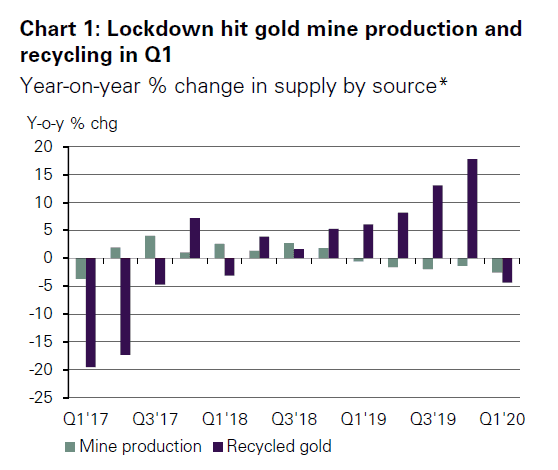
Total gold production fell 3% y-o-y in Q1 which was a relatively moderate decline given the scale of the pandemic. Some mining countries had to extend into Q2 but they are all gradually easing with slowly boosting up the production.

Recycling activity was also affected in Q1, falling 4% y-o-y which was the lowest level in 2 years. (Chart 1)

The 6% rise in the US Dollar gold price during Q1 would normally have drawn out near market supply but this was weakened by the lockdown measures worldwide. The physical exchange of gold for cash was waved and consumers were instructed to take security in their homes and jewellery retailers were closed down temporarily which reduced the amount of gold onto the market.

Downstream capacity was reduced

Refinery operations were halted and the consequent reduction in global refining capacity meant that bars and coins couldn’t be produced as needed. However, in contrast to the supply chain squeeze, unaffected refineries increased production capacity in that time to meet some of the excess demand.

Logistical nightmares

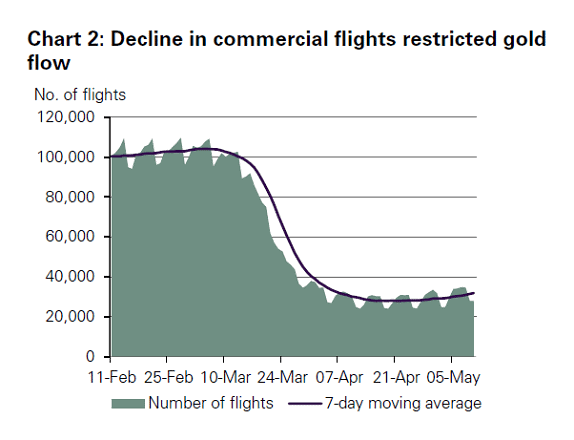
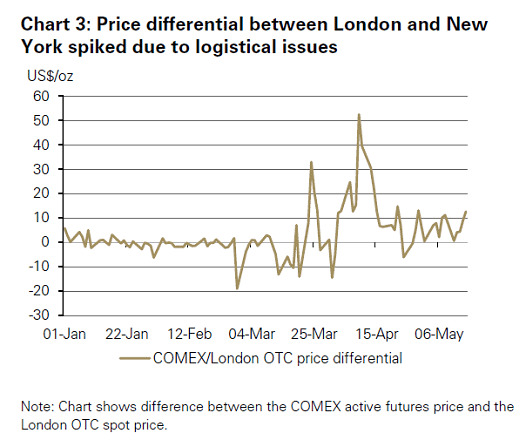
Supply chain disruption has not been focused only on sourcing and refining of gold but travel restrictions worldwide also delayed the gold flow along the chain. Gold transportation was of course negatively affected due to no transportation network, border closures, flight restrictions and in general travel restrictions leaving the supply chain looking for alternative means of transportation like chartering cargo-only aircraft.

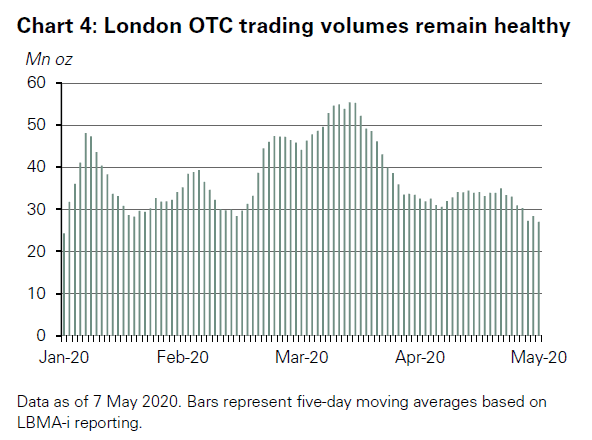
While the logistical issues have caused disruption to the free movement of gold which resulted in localised liquidity issues, overall liquidity in the gold market remained and remains booming.

Disparity in bars and coins supply

The Covid-19 outbreak took investors uncertainty to new highs against the existing global backdrop of low and negative interest rates and an anaemic growth outlook which fuelled in gold investment demand in Q1 as investors needed safe-haven assets particularly in US and Europe. Usually this demand could be met through various sources but in the current environment a disparity in the supply of LGD and retail bars and coins emerged.

Stock of LGD bars countered supply issues

In the wholesale market the availability and liquidity of LGD bars was relatively unaffected by the supply chain issues.

In contrast to gold futures on COMEX, which are linked to 1kg bars, most gold-backed ETFs (gold ETFs) are linked to LGD gold bars and these have benefited from the ample supply. In Q1, inflows into gold ETFs added up to 298t, the highest level of quarterly inflows for four years and the strong flows have continued through April and May.

This was supported by the large stock of LGD bars: at the end of January a record 8,263t of gold was held in London, valued at a record US$426bn. The stock of LGD bars enabled gold ETFs to source the gold required to back the large volume of newly created shares.

As gold volatility increased in Q1 the standardisation and deep stock of LGD bars helped maintain liquidity in the wholesale gold market, benefiting individual and institutional investors alike.

Higher premiums due to less small bars and coins

At the retail level, having market fragmentation, the story was notably different. Significant stocks of small bars (1kg or less) and coins were stranded in Eastern markets where demand was restrained throughout the quarter due to COVID-19. There were supply issues due to difficulties in transporting this gold easily and quickly to meet heightened demand in western markets.

Additionally, the availability of small gold bars and coins was further stretched due to their more complex supply chain. Small bars and coins need to be distributed throughout the globe to retailers and consumers.

Coin demand, in particular, jumped 36% y-o-y, with several mints reporting robust sales. Some dealer inventories had deficiency due to supply and logistical issues and many investors had long waiting times and high premiums. Premiums for American Eagle 1oz gold coins jumped to over US$130/oz (8% above spot), the highest level for six years, compared to an average of US$25/oz (2% above spot) over the first two and a half months of 2020. Such elevated premiums should narrow considerably since the gold supply chain matters begin to ease and anecdotal evidence seems to confirm this.

Result

Covid-19 pandemic has caused significant supply-chain disruption but temporary suspension of some mining and refining activities and strict travel restrictions created remarkable challenges to the movement of gold within the market. Nevertheless, amongst these challenges the resilience of gold supply chain has shone through. Mine production and gold recycling have declined only modestly and the depth of stock of LGD bars as well as the adaptability of market participants has supported high gold investment demand.

In recent weeks the easing of certain COVID-19 restrictions has alleviated some pressure on the supply of gold. While the dislocation between the London OTC market and COMEX remains elevated, we expect that some of the dislocations that have arisen due to supply chain matters should be reduced or even eliminated, ensuring the continued smooth and efficient functioning of the entire gold market.

This article is based on information provided by the World Gold Council.


We do not offer investment advice:

This information is provided solely for general information and educational purposes. It is not, and should not be construed as, an offer to buy or sell, or as a solicitation of an offer to buy or sell, or as investment advice in general.

Interested in buying and storing gold?
Please contact us through the form below and we will be happy to revert to you.


USD 10 Million Silver Deal Sealed Yesterday

Silver has been underrated since many years and investors and analysts believe that the silver price is about surging. Silver investors trust in silver because it is mainly used in the industry and thus less subject to speculations.

We are proud to announce that we sealed a USD 10 million silver deal yesterday. The delivery is agreed to take place in several batches during the coming few weeks. 

The entire amount will be delivered to our high-tech vaults in Liechtenstein in form of silver standard bars, 31.1 kg each.

The entire deal of USD 10 million silver will make almost 17 tons, being around 550 sliver standard bars.

The silver will be stored in our high-tech and high-security vaults in Liechtenstein, which are certified as Security Grade X (10), being one of the safest vaults in Europe. Furthermore, we do provide 100% insurance coverage, which is confirmed by our insurers in form of a so-called Certificate of Evidence of Insurance (EOI), issued by our insurers in the name of the client.

Our clients have 24/7 access to our facilities in case they wish to inspect their precious metals stored with us.


We do not offer investment advice:

This information is provided solely for general information and educational purposes. It is not, and should not be construed as, an offer to buy or sell, or as a solicitation of an offer to buy or sell, or as investment advice in general.

Interested in buying and storing silver or gold in our private vaults in Liechtenstein?
Please contact us through the form below and we will be happy to revert to you.

Daniel Lacalle: The Reasons for Gold

Why is it important to invest in gold, despite a strong US Dollar and huge injections of fresh money into the markets?

Published on Youtube by Daniel Lacalle.
Daniel Lacalle is not just only one of many economists in the world, but one of the most important capacities defending the fundamentals of resilient economies. Daniel holds a PhD in Economy, is a Senior Economist, has a CIIA title, post-graduated with a degree in IESE; he holds a masters degree in Economic Investigation, is a lecturer, well sought-after author, keynote speaker and a Austrian School fellow. Daniel Lacalle summarises the main reasons to invest in gold despite a strong US Dollar and huge injections of fresh money into the markets as following:
  1. Emerging markets demand: as their currencies are not stable but rather collapsing.
  2. Central Banks: While injecting funds into economies, Central Banks stabilize themselves with gold reserves.
  3. Status as reserve of value: It is unchallenged that gold is used for transactions since long centuries, while believe in fiat currencies is relatively new.
  4. De-correlation of gold: Gold is a de-correlated asset, while equities and bonds are increasingly correlated.
Enjoy watching while understanding why gold is a must-have in your portfolio to preserve your wealth.

We do not offer investment advice:

This information is provided solely for general information and educational purposes. It is not, and should not be construed as, an offer to buy or sell, or as a solicitation of an offer to buy or sell, or as investment advice in general.

Interested in buying and storing gold in our private vaults in Liechtenstein? Please contact us through the form below and we will be happy to revert to you.

Gold – Wealth Preservation since 4000 Years

First Class Services – Gold Sales and Private Vaulting

The discerned investor requires exclusive service at top level. We provide it, but do not advertise it.

It starts with a private jet airport only 45 km from our vaulting premises in Liechtenstein. You will be personally welcomed at the airport by one of our directors in Liechtenstein and chauffeured to our state-of-art vaulting facilities.

After an amicable conversation in our VIP meeting room (photo below, with gold-plated wall) you will be guided on a private inspection tour through our facilities, which will include two or three vaulting rooms (including the bonded duty-free area), our assay laboratory, our inspection room where our clients are welcome to view their precious metals stored with us at any time (24/7), and our private safes department.

We rightfully pride ourselves with our highest security standards technically possible. Our modern and high-tech vaulting facilities are so safe that we even do not need armed security guards.

Finest Gold and Silver

We will provide your needs for physical gold and silver exclusively from LBMA certified refineries in Switzerland, with a purity of 999,9 for gold and 995,0 for silver. To provide you with additional peace of mind, all gold bars of 1 kg delivered by the refineries to our facilities are undergoing our own assay, one by one. Smaller gold bars are assayed on random basis at a high percentage.

Exclusive Storage

We store your precious assets exclusively in segregated form and in your name. We will be providing you with detailed storage reports, listing the seal numbers of your individual storage boxes, the code of location within our vaulting facilities, the name of the producing refinery, the serial number of every single bar, each bar’s gross and nett weight.

For additional security, you might desire your own individual safe deposit cabinet, which we keep available for you in various sizes for up to 1,500 kg of gold.

Unmatched Insurance Cover

We will be providing you with your own Certificate of Evidence of Insurance (EoI), issued directly by our insurers in your name and stating the total value insured. We have not yet seen such a service provided by any other vaulting service.

The insurance coverage includes, among others, embezzlement by staff, managers and owners, as well as terror acts.

Client gold and silver stored with us under insurance cover currently amounts to over 1.5 billion Swiss Francs.

Absolute Discretion – No Reporting

As a private non-bank company, we are not subject to any reporting requirements such as CRS (automated exchange of information) or similar.

Your privacy is our top priority. Therefore, we do not store any data in the cloud or in data centres. Our entire IT and data storage system is exclusively kept in-house at our premises in Liechtenstein.

Depending on your instruction to us, storage reports and certificates of Evidence of Insurance may be issued in the name of your client number with us.

Worldwide Deliveries

Should you wish delivery of your gold or silver stored with us at any time, we will be happy to arrange for security transport to any location in the world where security ground services exist.

You will be in good hands…

We serve clients and friends (well, that is what our clients typically become after only a short time being with us) from the Middle East and North Africa since long years. We are not only familiar with the local culture of the Middle East but we do love it.

For our faithful clients from the Middle East and beyond we are providing certified, fully Shariah compliant services based on the AAOIFI Shariah Standard No 57 on Gold.

Please send us a message through the form below, and the director of Liemeta ME, Mr Stefan Nolte, will call you back at your convenience.


We do not offer investment advice:

This information is provided solely for general information and educational purposes. It is not, and should not be construed as, an offer to buy or sell, or as a solicitation of an offer to buy or sell, or as investment advice in general.


Gemstone and Jewellery Custody

We pride ourselves on counting some of the most substantial gemstones investors of Europe and of the Middle East as our clients. And we feel honoured to be the first choice for renown families to safeguard their priceless family jewelleries, which partly consist of precious pieces owned since generations.

With our state-of-art private vaults in Liechtenstein, we offer the highest security level available for private clients in Europe. Our modern high-security storage facilities are certified as Security Grade X (10), which means that professional burglars would need 10 hours to reach the locations in our building where gemstones and jewellery is stored in individual sealed boxes. For clients who desire even more security we offer the additional option to rent safe deposit boxes and strongboxes.

Our building and all our vaults are under continuous surveillance and equipped with various high-tech alarm systems that are connected to both a specialised private security firm and the police headquarters of Liechtenstein, which is in walking distance to our facilities.

Our vaults are climatised and equipped with automated fire extinguishing systems. Our safe deposit boxes and strongboxes are fire-safe.

Absolute discretion is our motto, whether our clients opt for custody in our hands-free collective vault rooms or for their own safety deposit boxes or strongboxes.

Visiting and revisiting gemstones or jewelleries in custody with us is not limited to specific days or hours. We are happy to welcome you at any time of any day throughout the year.

We provide one of the best insurance coverage available, including full coverage of embezzlement by staff, managers and owners. We are the only private vaults facility in Europe that provides its clients with a so-called Certificate of Evidence of Insurance, issued by our insurer MARSH (or other Lloyds underwriters) in the name of our clients.

We provide duty-free bonded warehouse storage, whether a client prefers to store in our collective vaults or in their own safety deposit boxes or strong boxes.

Last but not least, we provide security transport services from and to anywhere in the world where security ground infrastructures exist.

We are an independent, non-bank and family-owned and -managed company. We look after our clients like we look after our own family members.

If you want to know more about our unique and distinguished services, please contact us through the form below or, why not, visit us and see with your own eyes.


QE, Stock Bubbles, Coronavirus and Gold

The USD gold price did tank during the 6 and 19 March this year, as a result of huge sales of gold contracts, mainly at COMEX. Holder of gold contracts (futures, options, ETCs etc.) were massively selling their contracts, trying to convert preferably gold contracts to cash, as the gold market is one of the most liquid markets globally. Coronavirus did rightfully irritate investors and thus caused panic. However, if gold is compared with stock markets on the medium term and longer term, we see that gold is still a safe haven. And it will stay as a safe haven.

A quick glance on the above table shows the price development of gold and silver, compared with oil and selected common stock indices.

People who trust in gold as a safe haven buy and keep physical gold and do keep it on the long term. People who bet on a short- or medium-term price movement (either up or down) invest in gold contracts, including so-called gold-backed ETFs. The preference for physical gold to preserve wealth is clear; only physical gold has an inherent value without being exposed to risks that may come from any counter-liability, being the liability of issuers.

While all stock indices created serious losses during the last three, six and twelve months, most of them in the double digits up to -25%, only gold provided its holders with a substantial gain, proving its quality as a safe haven.

The World Gold Council just announced that Central Banks currently hold almost 34.000 tonnes of gold as reserves, equalling to 17% of all gold above-ground globally.

While safety and liquidity are paramount for reserve managers, the World Gold Council said further, returns are important too: gold has provided an average annual return of nearly 10% in US dollars since 1971.

Central banks may base their investment strategy on numerous factors, but the primary reasons for recent gold buying are: heightened economic and political risks, low and negative interest rates, and allocation re-balancing.

Silver did not make its holders happy during the last 12 months. But forward-looking investors see this as a serious gain potential, as silver looks undervalued.

Where will the gold price head to?

The US investment bank B. Riley FBR upped its gold price forecasts for Q3 and Q4 2020 to USD 2.500 per ounce.

“Regardless of how much longer recession conditions will continue and how much further general equity markets might retreat, extreme monetary and fiscal stimulus policies being enacted on a global basis will have repercussions,” B. Riley FBR’s note stated. “These repercussions will likely parallel 2009-2011, and drive gold price to new highs.”

The stock markets are creating bubbles over the last years. Investors do not invest in stocks based on companies’ real value and market perspectives but based on the speculations of other investors. How else could the stock prices of companies like Tesla, Apple, WeWork and others be explained? Stock investors are building up each other’s investment momentum and are led by that momentum, losing any connection of their investments to the reality of the companies of which they trade shares.

QE, Quantitative Easing, or the artificial creation of funds through indebting and re-indebting debts, does not suggest any trust in money markets anymore. Global corporate and public indebtedness are reaching 250% of the global GDP. Almost 50% of US corporate debt is one step away from junk.

Coronavirus and Gold

The recent tumbling of the gold price by about 13% was caused by the market irritation as mentioned at the beginning of this article. 13% tanking was moderate compared with stock indices. Since 20 March, the gold price recovered, reaching USD 1.632 right now (26 March 2020, GMT 3:22pm), returning to a price level that is supported by fundamental measures.

Apart from that it seems that there will be another impact which might further push the gold price up.

Italy is expected to lose 12% of its GDP in 2020, Spain 11 and Germany 8%, just to name a few. Economists in the US expect a drop of production in 2020 of up to 24%.

The coronavirus pandemic will be handled within a few months as it seems. Hopefully!

However, the economic damage created by the pandemic will not be repaired or compensated within a few months. Expected USD 3,4 trillion loss in salaries alone will be a serious obstacle for consumption increasing again once the pandemic ends and shops open again.

Central Banks will try to fight the lack of consumption with even more QE, which will erode trust in the monetary systems and their managers even more as well.

That’s why the US investment bank B. Riley FBR upped its gold price forecasts for Q3 and Q4 2020 to USD 2.500 per ounce.

As a consequence of the above situations, experts do not expect the demand for physical gold decreasing during this year, at least.


We do not offer investment advice:

This information is provided solely for general information and educational purposes. It is not, and should not be construed as, an offer to buy or sell, or as a solicitation of an offer to buy or sell, or as investment advice in general.

Interested in buying and storing gold in our private vaults in Liechtenstein?
Please contact us through the form below and we will be happy to revert to you.

Quick Market Update: Global Run on Physical Gold Already Tightening Supplies

Zero interest on US Dollar, extreme money supply in the US, overrated stock markets and the fear for an increasing recession and of the Coronavirus caused a crazy run on physical gold as we have not seen it before.

The US mint announced that they can not supply some of their coins and only smaller quantities of their other coins. Retail gold sellers in Germany and other European countries saw an increase of sales of 50 to 60%, compared with March 2019.

Gold premiums went up substantially in Asian markets and are expected to rise in European markets as well.

We witnessed an increase in sales of around 50% during the last 3 weeks. Increased demand is coming especially from large clients, buying gold for up to double million digits. Increase in new client applications is 100%.

Situation of Gold:

Buyers and the market in general fear a closure of the borders of Switzerland, as it is one of the countries hit hardest by the Coronavirus. The precious metal refineries in Switzerland mostly employ commuting workers from Italy and from France, who then would not be able to come to work anymore.

In that case, Swiss refineries would have to reduce their production drastically, if not to closing down completely. Consequently, gold could only be provided from secondary markets, which would increase gold premiums substantially.

GOLD UPDATES 24 March 2020:

  1. The three main refineries for precious metals in Switzerland are now closed.
  2. The Royal Mint of Canada closed to protect its workers.
  3. Dubai will prohibit export of gold from tomorrow (Wednesday, 25 March 2020)
  4. Gold price passed USD/oz 1.600 today.

However, we are still able to deliver for the time being:

  • 1.000 g fine gold bars 999,9, primary market, directly from Swiss refineries
  • 100 g fine gold bars 999,9, primary market, directly from Swiss refineries

Price fixing upon arrival of client transfer on our bank accounts in Liechtenstein; delivery and storage in our high-security vaults in Liechtenstein around end of March 2020. Fixing with price limit order is possible.

At the time being we are ordering from the Swiss refineries gold for several millions on a daily basis.

Unlike many other gold sellers in other countries, our premium on gold increased only marginally. The marginal increase is caused by drastically increased transport insurance fees, due to the inclusion of virus contamination risks.

Situation of Silver:

Silver Standard bars (31,1 kg) are not available at the moment as Mexico stopped its exports, due to the crazy situation in the world (volatility of markets etc.). The government of Mexico prefers to hoard their national wealth.

1 kg silver bars are available, but the premium is too expensive at the moment to our opinion. Still, people do buy.

The silver price tumbled because of mass sales of future contracts by investors (speculators) who believe in a steep fall of demand for silver, as silver is mainly used in the industry (recession because of coronavirus and of other global market issues).

SILVER UPDATES 24 March 2020:

  1. Many silver mines around the world have been closed.
  2. The closure of the three main refineries for precious metals in Switzerland does effect silver supply negatively.
    This will, contrary to what we wrote above, increase the demand in silver.
  3. 1 kg silver bars are not available at the moment in larger quantities and they also cannot be ordered.#
  4. Premium on Silver Standard bars went up to 27% in Singapore
  5. But we are now able again to sell and store Silver Standard bars (31,1 kg)! Supply changes continuously, please ask us for current availability. Our premium is only at about 15% at the moment.


We do not offer investment advice:

This information is provided solely for general information and educational purposes. It is not, and should not be construed as, an offer to buy or sell, or as a solicitation of an offer to buy or sell, or as investment advice in general.

Interested in buying and storing gold in our private vaults in Liechtenstein?
Please contact us through the form below and we will be happy to revert to you.

Global Coronavirus – Covid-19 Crises: Protecting your wealth with Gold

The global Coronavirus crises already created global financial damage, and the damage does not seem to as it is currently. Interruption of global delivery chains, cancellations of exhibitions and an global travel limitations seem to continue for a while. It is again gold that appears as safe haven and preserves wealth.

Since the outbreak of Covid-19 on 12th of December 2019, gold gained 12,05% until now (3rd of March 2020 at 06:02 pm GMT; the gold price being USD 1.647,14,) while, for example, S&P500 lost 2,43%.

JP Morgan slashed global GDP 1Q20 by 50%

On 20th of February, JP Morgan slashed the global GDP growth forecast by 50% for 1Q20, from 2,6% to 1,3% annualised rate. A global GDP decrease of 1,3%, as forecasted by JP Morgan, translates to a global damage of about USD 886 billion.

JP Morgan revised China’s GDP 1Q20 down to 1% quarter-over-quarter when seasonally adjusted, down from a pre-virus forecast of 6.3%. China is the world’s largest economy. It produces raw materials, raw products and end products for the entire world. The key position of China becomes more comprehensible if you look at the production of antibiotics: almost the entire raw material for the global manufacturing of antibiotics is produced in China.

China is also important as a market for all major global producers. The harsh anti-virus measures in China has its price, local consumption decreased dramatically, car sales are down by 25%.

Gold gained 27% during the SARS crises 2003/2004

The SARS epidemy in 2003 caused a global damage of USD 40 billion, while the Coronavirus already caused by far more tragic deaths than SARS. During the SARS crises, gold gained 27% value and continued gaining until today.

Gold remains as a reliable preserver of wealth on the long term. Regardless the current virus crises, the fundamental weaknesses of our global markets remain unchanged. That’s why Citibank sees gold topping $2,000 in next 12 to 24 months, and Citibank is only one of large wealth managers sharing this opinion.

Since months, gold buyers are heavily purchasing gold at increased quantities. While some gold buyers are speculating on the short-term increase of the gold price, other buyers focus on long-term asset protection and thus buy physical gold that they store safely in private vaults in custody.

We do not offer investment advice:

This information is provided solely for general information and educational purposes. It is not, and should not be construed as, an offer to buy or sell, or as a solicitation of an offer to buy or sell, or as investment advice in general.

Interested in buying and storing gold in private vaults?
Please contact us through the form below and we will be happy to revert to you.

Gold Demand Fell 1% in 2019 With Q4 Showing Weak Consumer Buying

A quick look at the headline numbers for gold demand may leave one perplexed. The overall demand for gold in 2019 fell by a small amount globally, but underneath the surface, there are some interesting demand currents emerging.

Central banks continue to be big buyers of gold. In 2019 central banks extended their decade-long buying spree of the yellow metal, although the gross tonnage was slightly below the 50-year record that was set in 2018.

Investors are also adding to gold positions, although ETFs appear to be the big beneficiaries of investor demand for gold so far. Gold ETF inflows jumped by more than 400% from 2018, as global investors added exposure to gold via exchange-traded funds.

The real weakness in gold demand in 2019 was solely focused on the retail gold buying sector. Demand from retail clients in China and India fell markedly in 2019, as higher gold prices appear to have turned potential gold buyers into sellers of their golden items.


How to read this post:

This report is based on the research results of the World Gold Council (WGC). The WGC is financed by its members, mainly being gold mining companies in various countries.
The data sources for WGC’s researches are publicly accessible data and data provided by gold mines, refineries, fund management companies, Central Banks etc. There are indeed market participants that do not provide their data. The results of the WGC’s reports have to be read and understood in that context. For example, the demand in bars and coins (further below) is mainly based on production figures of refineries. Consequently, they do not include the demand of buyers who buy bars and coins that were already produced and, in the market (stored in storage facilities of banks, non-bank vault providers like Liemeta and others). In fact, the demand for bars and coins in 2019 in Germany increased by almost 20%, in contrast to the figure given below.

Central Bank Gold Buying Continues

Central banks continued to add substantial amounts of gold to their reserves in 2019. Overall central bank buying of gold stood at 650.3 tons last year, a slight drop from the previous year. 2019 was still the second-highest year for central bank gold demand in 50 years, with 2018 taking the top spot.

Emerging central banks were the chief buyers of gold in 2019, with Russia, Turkey, and Poland adding more than 90 tons to their reserves. China, Kazakhstan, and India also added their gold reserves, although at lower levels. The Q4 2019 gold buying levels were far more subdued than 2019, with y-o-y buying falling by 34%.

Overall, 15 global central banks added to their gold reserves in 2019, with
2019’s
gold buying falling just shy of 2018’s 50-year record-setting levels.

The past year marks a decade since central banks shifted to being net buyers of gold, and it appears that the trend towards adding reserves is strong. Few expected the record level of central bank gold buying in 2018 to continue, but it appears that monetary authorities in emerging markets are looking for alternative reserve assets.

Consumer Gold Demand Falters

Consumers were the weak area in the gold demand picture in 2019. Q4 2019 saw a big drop in demand from both Chinese and Indian retail gold buyers, as higher prices appear to have dented demand in these traditionally strong gold markets.

Jewelry demand for gold dropped by 6% for 2019, but the drop in Q4 was 10% lower than the same quarter in the previous year. A changing gold market in India was largely responsible for this drop in demand, but shifting consumer trends in China may also be playing a role.

The middle of 2019 saw a big surge in gold prices, which pushed prices to a record high in Indian Rupees (INR). While the total volume of gold purchased in H2 2019 fell from the previous year, the price of the gold that sold as jewelry rose by 3% in USD terms.

The high price of gold seems to be been at least partially responsible for the volume weakness in global jewelry buying, although the USD value of the gold that was bought by consumers came in at a 5-year high of 94.3 billion USD. The Q4 rise in gold prices drove the value of the gold bought for jewelry up by 9% on a y-o-y basis, to $27.8 billion USD, a seven-year high.

Changing Consumer Trends

In addition to higher prices, the Indian gold market is in the middle of a transition to standardization. While it is unlikely that the recent move by the Bureau of Indian Standards (BIS) to implement its plan to standardize all the gold bars and jewelry sold in India by 2021, it may have an effect on prices in the near term as jewelers remanufacture old ungraded stock into new pieces.

Higher prices and a slowing economy led to a 10% drop in Chinese consumer gold demand in Q4 2019. The Chinese market for retail gold purchases is also likely to remain soft in the near term. Chinese GDP growth slowed in Q4 2019, and the recent outbreak of a novel coronavirus in central China is likely to have an outsized impact on Chinese consumer spending for the rest of the year.

In fact, the higher gold prices that are emerging in early 2020 may serve to bring more recycled gold supply onto the market, as was the case in 2019. The price rise that began in June of 2019 helped to boost recycled gold supply by 11% over 2019, and it is likely that most of this came from consumers who were looking to lock in higher prices for their gold items.

Investors Flock to Gold Positions

Investors appear to have taken the opposite view of a rising gold price in 2019. As consumers reduced their purchases of gold, investors gained exposure to gold-linked products last year. The primary beneficiary of renewed investor interest in gold were paper gold products, like futures contracts and gold ETFs.

The overall level of gold investment in 2019 rose by 9% y-o-y, but this number doesn’t tell the real story. Physical gold investment products saw a double-digit decline in demand, as the paper gold market skyrocketed.

Demand for gold ETFs jumped by 426% in 2019, as demand
in the bar and coin market fell by 20%.

The weakest area for physical gold investment products was China, which saw a staggering decline of 31% on an annual basis. The amount of gold that ETFs control reached a record high in Q4 2019, with 2885.5 tons. More than 400 tons of gold flowed into ETFs during 2019, which lifted the total AUM by 18% over the year, to 141.1 billion USD.

US futures were also a popular way to invest in gold, with open interest in COMEX gold futures reaching record highs in September 2019, at the equivalent of 1,134 tons represented by net long contracts.

The interest in gold-linked investment products is no longer a US-based phenomenon. Four years ago US-based ETFs comprised two-thirds of the global total, but today, they are more or less tied with European gold ETFs, which hold 1,332.1 tons. This is double the amount that European gold ETFs held four years ago and demonstrates the rising demand for exchange-traded gold products from investors in the West.

Gold Prices Hit Record in Multiple Currencies

The price of gold averaged $1,481 USD/oz in Q4 2019, but it hit record highs in other major currencies. Gold hit a record high in Euros, Turkish Lira, Indian Rupees, and the South African Rand in Q4 2019. This strength does appear to have dented demand from consumers, but investors and central banks remained buyers despite the higher price of gold.

One big reason for this unrelenting interest from sophisticated financial professionals is likely the ongoing ultra-low interest rate environment. Most major central banks are on hold, and given the recent global shock emanating from China’s virus problems, it would be conceivable that central banks will provide economic stimulus as 2020 unfolds.

The total supply of gold was able to avoid a contraction in 2019 due to gold recycling, likely from consumers who were selling due to higher gold prices. If gold prices appear to find a footing at higher levels, this market dynamic may flatten or reverse.

Mine production of gold fell by 1% in 2019, and by 2% in Q4 of last year. This marks the first annual decline in gold production since 2009 and the dark days of the last global financial crisis. The overall production from global mines in 2019 was 3,463.7 tons.

It is easy to see that the smart money is moving into gold-linked investments, and in the case of central banks, physical reserves of gold. Consumer demand for gold may remain weak for the remainder of 2020, as the global economy reels from the outbreak of a novel virus in China, which has yet to make its full impact on the global economy.


We do not offer investment advice:

This information is provided solely for general information and educational purposes. It is not, and should not be construed as, an offer to buy or sell, or as a solicitation of an offer to buy or sell, or as investment advice in general.

Interested in buying and storing gold?
Please contact us through the form below and we will be happy to revert to you.